
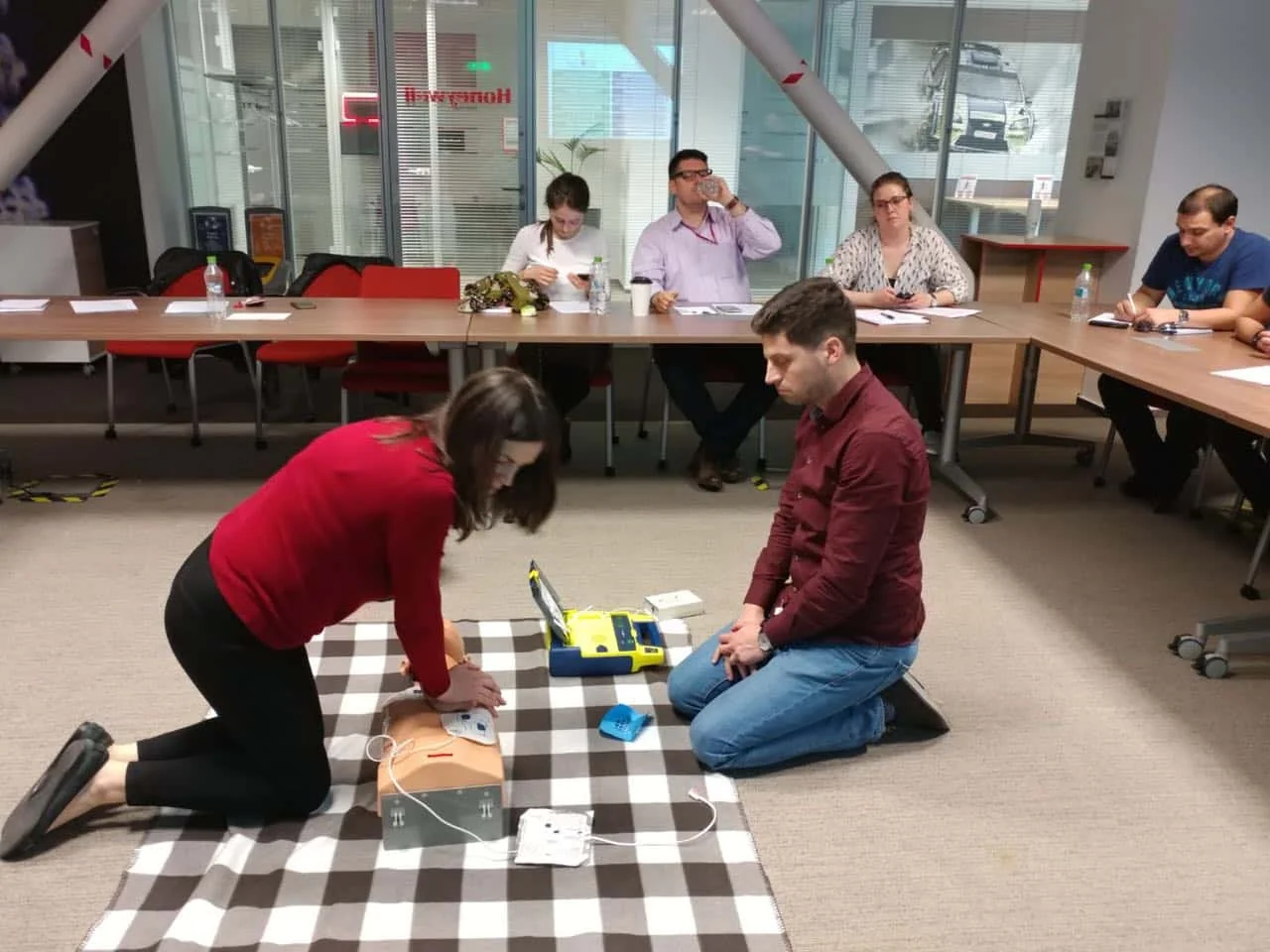
BLS-AED Courses - Basic Life Support - Automated External Defibrillation
Staff training for Basic Life Support (BLS) and Automated External Defibrillation (AED)
ISO Certified
Products certified to international standards
Quality Guaranteed
Over 20 years of industry experience
Fast Response
We respond within 24 hours
Full Support
Installation and maintenance services
Description
Following the guidelines of the European Resuscitation Council, in order to be able to recognize and provide effective first aid to people in difficulty, it is necessary to train designated personnel for Basic Life Support (BLS) and Automated External Defibrillation (AED).
Our objective is to provide competitive and professional services, offering high quality training courses, held in a direct, interesting and mostly...INTERACTIVE style!
This course can be followed by anyone who wants and considers themselves able to provide first aid. The course lasts 6 hours and the certificate issued after completing the course is valid for 2 years. The course is organized for groups of a minimum of 10 and a maximum of 15 people.
The course includes the following stages:
- Introduction
- Course objective
- Basic Resuscitation – current protocols/chain of survival
- Basic Resuscitation – Practical assessment of skills
- Using an AED – Statistics
- Description of an AED
- Demonstrations with an AED
- Practice using an AED (Individual work)
- Practical scenarios (Group work)
- Individual assessment
- Conclusion
Video materials, a resuscitation dummy and an Automated External Defibrillator (AED) are used throughout the course.
The success of resuscitation is determined not only by the correct performance of resuscitation techniques but by many more factors that are interrelated. All factors that interfere with the success of resuscitation are included in the notion of the chain of survival. This “chain” is made up of 4 links:
-
Rapid recognition of an emergency and early alarming of an emergency medical system.
-
Early initiation of basic life support (BLS) is the second link in the chain of survival.
-
Early defibrillation is the maneuver that decisively influences the success of an adult resuscitation.
-
Rapid initiation of advanced life support (ALS) is the last link in the chain of survival and is provided by qualified medical personnel.
Most cases of cardiac arrest in adults are initially based on ventricular fibrillation (VF). The only effective treatment for ventricular fibrillation is defibrillation. In this case, time is the key factor!
Numerous studies have focused on analyzing the time that elapsed until defibrillation occurred in the case of cardiopulmonary resuscitation on subjects who survived a cardiac arrest. For every minute that passed between the crisis and defibrillation, the survival rate of victims decreased by 7 to 10% if first aid was not provided.
Ventricular fibrillation spontaneously changes. Ultimately, it is the defibrillator that saves lives. Make sure you have one on hand in case of need.
Remember when fire extinguishers were optional? Soon, AEDs will be available on a similar scale. When AEDs are widely used, every citizen will be part of the emergency system, increasing the possibility of saving lives!
We want to be flexible and communicative, working hand in hand with our clients to provide them with a set of training programs that are in line with their statutory requirements, while respecting the requirements of the European Resuscitation Council.